The Command Palette is a searchable list that runs any SumatraPDF command, and also opens files, switches tabs and jumps to pages, table of contents entries, favorites, annotations and settings. Open it with
Ctrl + K or View → Command Palette.Available in version 3.4 or later.
Press
Ctrl + K, type a few letters, press Enter to run a command. Type a prefix character to switch what the list shows:- Commands:
>lists all SumatraPDF functionality (the default view) - File history:
#opens a previously opened file - Tabs:
@switches to another tab - Thumbnails:
&navigates pages with thumbnails - Table of contents:
%jumps to an entry in the current document - Favorites:
$jumps to a favorite (current document’s first, then others) - Annotations:
*jumps to an annotation in the current PDF - Settings:
=changes a setting - Combined view:
:shows everything in one list
Typing
>, @, #, $, %, & or = while the document has the focus opens the palette directly in that mode. Each mode is also a command for keyboard shortcuts: CmdNavigateTabs, CmdNavigateHistory, CmdNavigateFavorites, CmdNavigateTableOfContents, CmdNavigateThumbnail and CmdQuickEditSettings (see CmdCommandPalette).Run a command #
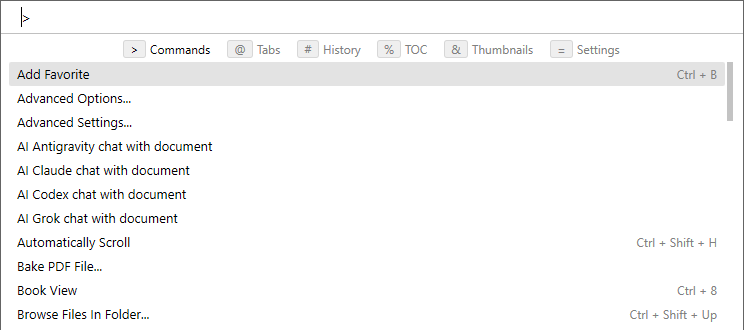
- Press
Ctrl + K, or use View → Command Palette (CmdCommandPalette). - Enter text to narrow down the list of matches.
Up/Downarrows navigate between matches.Page Up/Page Downjump a page of matches.Home/Endgo to the first / last match when the caret is already at the start / end of the query (Ctrl + Home/Ctrl + Endalways do).Ctrl + Aselects the query.Ctrl + Ccopies the selected query text (Ctrl + Vpastes into the query).Enterexecutes the selected match (or double-click it with the mouse).Escapecloses the window (or click outside it).
A command can be listed under more than one name so that a different wording finds it. For example, Navigate Files in Folder… is also Browse Files In Folder…, and Advanced Settings… is also Advanced Options….
Switch to another tab #
Type
@ to switch between open tabs: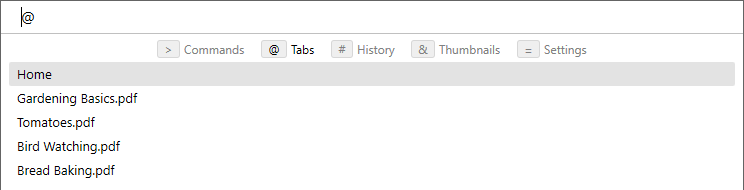
Open a file from history #
Type
# to open a file from the list of previously opened files: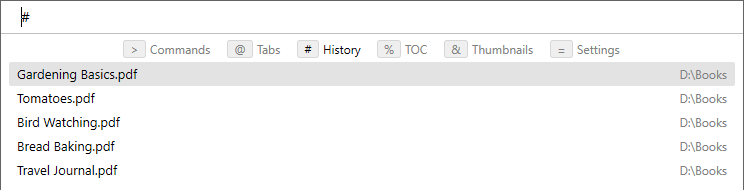
Jump to a table of contents entry #
- Type
%. - Press
Shift + F12(CmdNavigateTableOfContents). - Add
CmdNavigateTableOfContentsas a toolbar button.
The list shows the fully expanded table of contents of the current document, indented to reflect the tree hierarchy. The entry closest to the current page is pre-selected. Type to filter, then
Enter (or double-click) to navigate to the selected entry.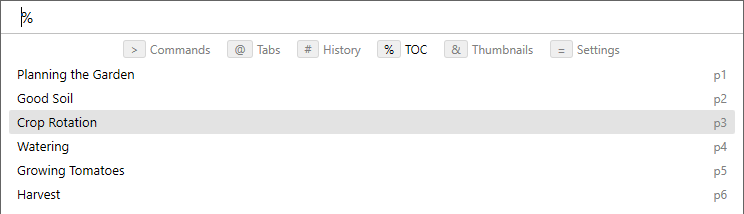
Jump to a page with thumbnails #
Type
& to open the thumbnail grid for the current document. The current page is selected initially. Use the arrow keys, Home, End, mouse, or the scrollbar to navigate. Enter opens the selected page and Escape closes the grid.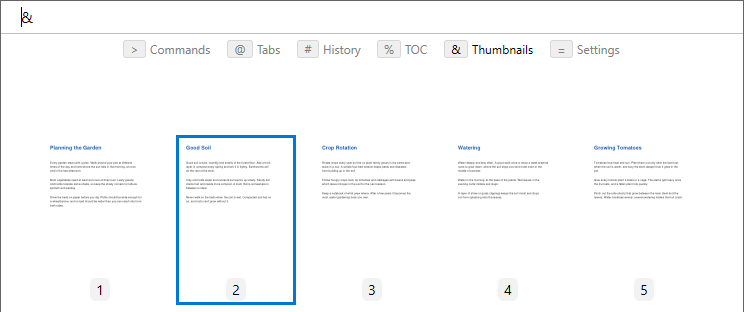
Jump to a favorite #
- Type
$. - Bind a keyboard shortcut to the
CmdNavigateFavoritescommand to open the palette directly in favorites mode (see Managing favorites). - Add the same command as a toolbar button.
Favorites (bookmarks) of the current document are listed first, followed by favorites of other documents (labeled with the file name). Type to filter, then
Enter (or double-click) to navigate to the selected favorite. Picking a favorite in another document opens that document.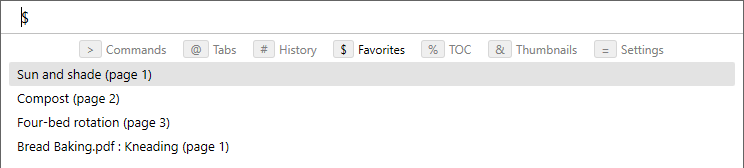
Jump to an annotation #
Type
* to jump to an annotation in the current PDF. * Annotations appears in the mode row once annotations have been collected and the document has at least one. Collection runs in the background the first time the Command Palette or Find Annotation needs them, and the result is reused (including when there are none).Rows match the Find Annotation list: type, contents, page number. Filter with the same syntax (
:t=text, :a=kjk, :c+, plain words). Enter or double-click selects the annotation and jumps to it.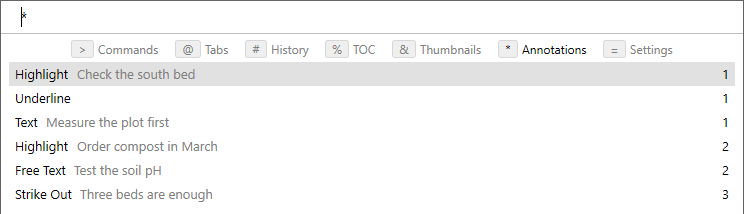
Change a setting #
Type
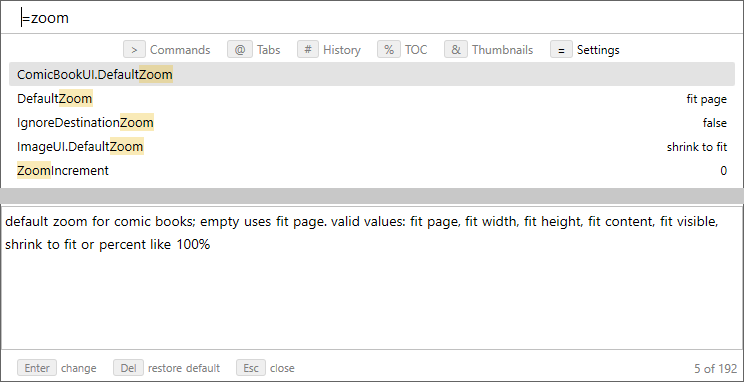
= to change a setting without opening Advanced Settings.- Every setting holding a single value is listed by its dotted name, with its current value on the right.
- A value that isn’t the default is shown in bold, and those settings are listed first.
- Type to filter by name or by value.
- The selected setting’s description, the same as in Advanced Settings, is shown under the list.
Enter on a true / false setting toggles it. Any other setting asks for a value. The query becomes =<name> = <value>, and- a setting restricted to a fixed set of values (
Toolbar,Scrollbars,PrintScale, …) lists them. Type to narrow the list, andEnterpicks one - any other setting takes what you type, starting from the current value
The change takes effect immediately, exactly as if it had been saved from Advanced Settings, with no restart. The palette stays open and shows the settings again with the same setting selected, so several can be changed in a row.
Esc closes it, and Esc while a value is being asked for goes back to the settings instead, also with that setting selected.Delete (Cmd + Backspace on macOS) puts the selected setting back to its default, in the settings list and while a value is being asked for.You can also type the whole thing at once, e.g.
=ZoomIncrement = 25. The name can be the last part of a dotted setting (Units for FixedPageUI.PageGrid.Units) as long as only one setting ends with it.Note: compact settings like
WindowMargin are only editable in Advanced Settings, and settings holding a list are only editable in the settings file (Open Advanced Settings File…).Show everything in one list #
Type
: for a combined view (replicates 3.4 and 3.5 behavior):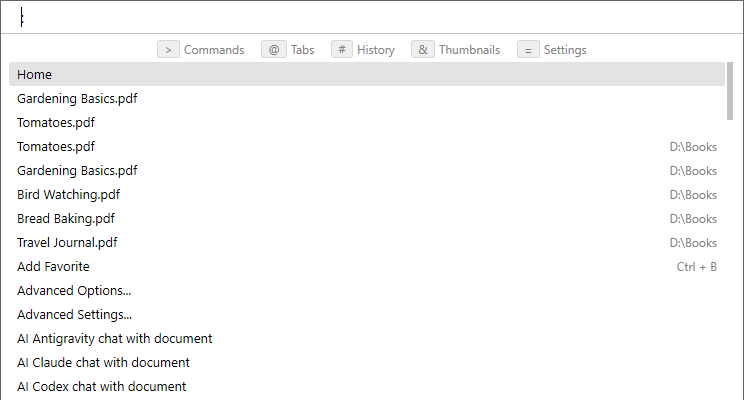
Tips #
- Use the palette to run commands that have no default shortcut, e.g.
Toggle Free Pan. - Type
=and a value to find settings by their current value. - Change several settings in a row. The palette stays open after each change.
- Press
Shift + F12to go straight to the table of contents.
Replicate 3.4 and 3.5 behavior #
In 3.6, we changed the default command palette view from combined (
:) to commands only (>).You can replicate pre-3.6 behavior by adding to advanced settings:
Shortcuts [
  [
    Key = Ctrl + K
    Command = CmdCommandPalette :
  ]
]
The default command for the
Ctrl + K keyboard shortcut is CmdCommandPalette. The setting above changes it to CmdCommandPalette :, which replicates 3.4⁄3.5 behavior.See also #
- Commands: every command id, for shortcuts and toolbar buttons
- Customize toolbar: palette buttons on the toolbar
- Managing favorites
- Advanced settings